graphical blog 2

29 August, 2010

Gestion du Galaxy S depuis GNU/Linux

Filed under: Android, (free) software, Everything, Tutorial in french, chinese 教育, system, ultra low voltage — Administrator @

La commande adb (Android Debug Bridge) de l’Android SDK de Google permet de se gérer le Galaxy S (et a priori, tous les terminaux Android/Linux) et de contourner partiellement ses bugs avec l’OS Android/Linux 2.1 et les bugs ajoutés dans la version FR/SFR.

Il permet de :
* Transférer des fichiers
* Installer des applications via les .apk
* rebooter en mode recovery (plus pratique que la combinaison de touche volume haut+home+On) ou bootloader (plus pratique que la combinaison de touche volume bas+home+On)
* remonter la partition /system en mode lecture/écriture (Peut-être nécassaire de rooter le périphérique auparavant ? Le mien est déjà rooté ;) ).
* exécuter un shell sur le périphérique Android, pour y exécuter des commandes et lancer des applications.

En effet, sur plusieurs modèles de la version SFR, le market ne marche plus, cela ne permet pas d’installer des applications vitales.

Pour contourner le bug du market, on peut récupérer sur Internet de nombreux paquets Android, les .apk. Ce sont des archives .zip, renommé .apk, contenant des directives d’installation et désinstallation et les fichiers à installer.

On peut généralement en trouver sur les sites de développeurs, quand ils n’ont pas limité leur distribution au Market, c’est le cas de nombreux logiciels dont les sources sont dispo sur code.google.com et sur différents sites alternatifs, avec parfois des fakes et parfois des listes complètes de logiciels, mais je ne sais pas dans quelles mesures ces sites contiennent des warez ou des applications distribuables légalement.

Utiliser ADB avec le Galaxy S
* Il faut préalablement passer le Galaxy S en mode debug (cela lance un serveur ADBd) :
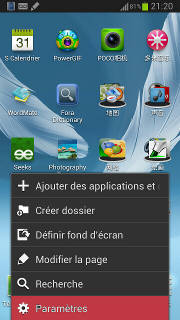
* Sur le Galaxy S : Menu=>Paramètres=>Application=>Développement=>Débogage USB
* Connecter ensuite le téléphone au PC via le port USB.
* Il faut qu’adb soit dans le chemin standard ($PATH), ou l’y ajouter, ou taper le chemin complet.
* Dans un terminal, utiliser (il faut lancer en root) la commande sudo adb usb pour détecter le périphérique et lancer le démon en root.

Vous pouvez alors utiliser toutes les commandes adb avec un utilisateur non root.

Installer les .apk, via ADB
* adb install fichier.apk

Il affichera si l’installation se déroule bien ou il y a une erreur, pas besoin de débrancher le téléphone, l’application apparait immédiatement dans l’interface.

Désinstaller un .apk
Il vaut mieux désinstaller à partir du téléphone (Menu=>Application=>Gérer les applications=>cliquer sur l'application à désinstaller=>Désinstaller)

Installer une mise à jour système ou un rootkit (via update.zip)

* Placer l’update.zip à la racine de /sdcard : adb push fichier_de_mise_à_jour.zip /sdcard/update.zip
* Rebooter en mode recovery : adb reboot recovery
* A l’aide du bouton bas de volume, aller sur Apply sdcard:update.zip puis presser sur le bouton Home (bouton physique carré du milieu en bas de l’écran) pour valider.

Il me semble qu’il reboot alors automatiquement, sinon, aller sur reboot system now
et valider (toujours avec le bouton Home).

Passer en mode bootloader
* adb reboot bootloader
ou bien
* adb reboot-bootloader

IME
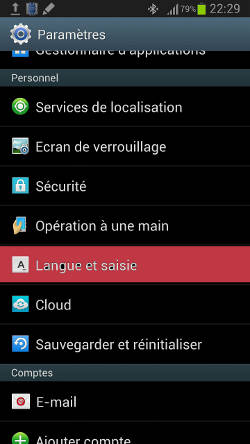
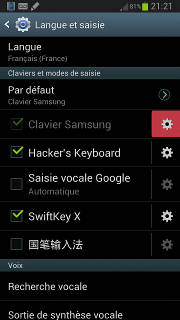
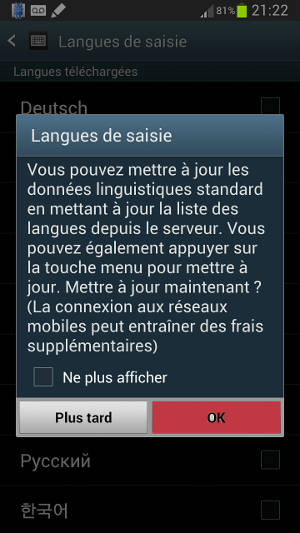
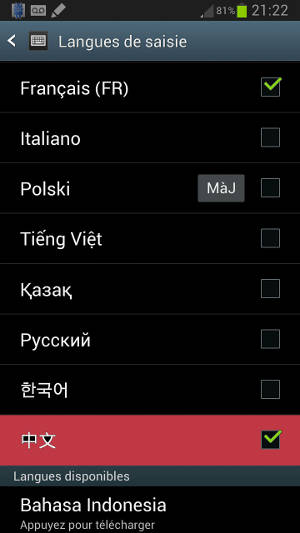
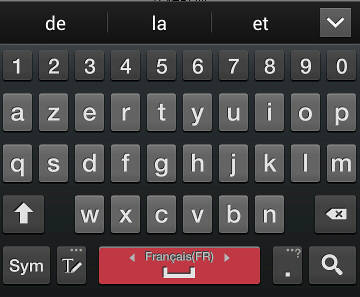
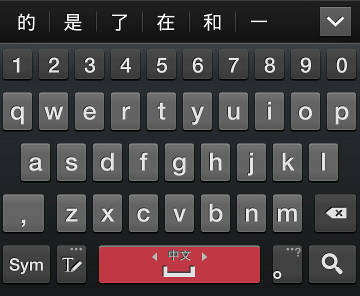
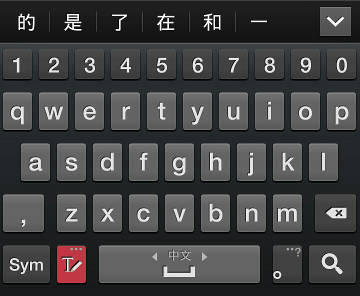
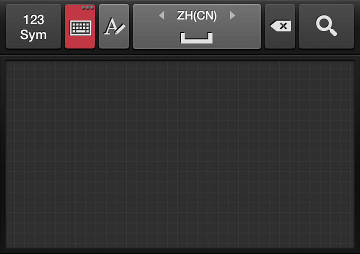
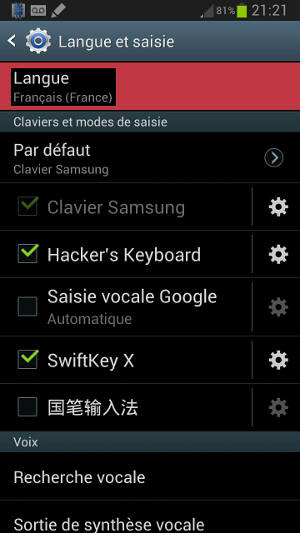
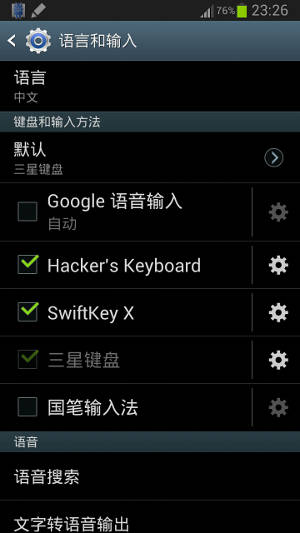
Concernant les outils manquants, mes principaux blocages étaient la méthode de saisie (IME) du chinois et du japonais. Dans tous les cas, après l’installation, il faut activer l’IME via : Menu=>Paramètres=>Paramètres de Langue=>Cocher la case de la méthode installée.

J’ai trouvé les quatre utilitaires suivants :
* Hanwritting (漢書) permet via l’écriture manuscrite sur l’écran (bon pour mémoire les caractères et pour les personnes âgées ne connaissant pas forcément les pinyin) d’entrer des caractères chinois traditionnel/simplifié/bopomofo, japonais (Kanji/hiragana/katagana), coréen(hanja/hangul), et européen (anglais uniquement). Je crois que je l’installé la seule fois ou le Market à fonctionné par miracle, je n’ai donc malheureusement pas trouvé le .apk. Démo Youtube
* Sogou pinyin input / 搜狗拼音输入法 (saisie pinyin, écrite simplifié/traditionnel) qui fonctionne très bien. Voici le Sogou Input apk / 搜狗拼音输入法.
Pour le récupérér :
1. Choisir la marque du portable à [手机品牌] : 三星 (sānxīng, signifiant 3 étoiles) pour Samsung, 诺基亚 (translittération) pour Nokia, etc…
2. Choisir le modèle à [手机型号], : 三星-I9000-8/16GB pour le Galaxy S
3. Choisissez la méthode de téléchargement (, lien direct .apk web (电脑直接下载), lien direct wap (WAP下载) ou encore SMS (短信下载)).

Il vaut mieux suivre cette procédure plutôt que mes liens pour être sur d’avoir la dernière version.

* Simeji, apk en bas de page, saisie du japonais via rōmaji, le meilleur que j’ai pu trouvé pour le moment en apk. Démo en vidéo
* Android Zhuyin IME (Android 注音輸入法), apk dans section Download, pour les Taïwanais, Hongkongais, habitants de Macao (comment on dit ?), Singapourien et autres Chinois de plus de 60 ans ayant appris avec le zhùyīn (注音 parfois appelé bopomofo).

Navigation libre basée sur OpenStreetMap
Les avantages d’OpenStreetMap sur maps.google : parfois plus précis, Contient la Corée du Nord ;), on peut améliorer à volonté, on peut récupérer en locale les tuiles bitmap, ou mieux les données vectorielles, bien plus compactes et permettant une meilleure navigation.

On trouve sur le Wiki d’OpenStreetMap (OSM), une page dédiée à Android

* OpenSatNav (opensatnav.apk sur la droite), ne gère que le tile bitmap, mais permet de gérer la taille du cache sur la SDcard, on est obligé d’être connecté via l’Androidphone pour récupérer les données.
* Navit on Android (apk sur la même page), il faut créer sa carte à l’aide de l’outil Navit :: Planet Extractor (il se synchronise régulièrement sur OSM), et placer le fichier généré sur la SDcarrd : adb push fichier_généré.bin /sdcard/navitmap.bin. On peut très bien avoir plusieurs fichiers sur la sdcard et les renommer (ou faire un lien symbolique depuis un shell en fonction des besoin d’utilisation). Tout est vectoriel, c’est rapide, 2D et 2,5D, j’adore. Il peut faire de la synthèse vocale via TTS. Après avoir mis la carte, il faut faire : Menu=>Actions=>Ville=>nom de ville=>Voir la carte, pour la voir.
* AndNav2 (andnav2_latest.apk). Il gère la boussole, mais n’affiche qu’en bitmap :(. Il faut à priori télécharger des cartes ici, puis faire :

adb push fr_paris_mapnik_15.zip /sdcard/andnav2/tiles/
adb shell
cd /sdcard/andnav2/tiles/
busybox unzip fr_paris_mapnik_15.zip

Des petites erreurs s’afficheront mais ça n’est pas grave. Si vous n’avez pas busybox (pas rooté votre phone), sous Gnu/Linux, vous pouvez utiliser libgphoto2 et le mode lecteur média de votre Samsung Galaxy S pour détecter le périphérique et y copier l’arborescence dézippée. Visiblement il continue à charger via internet malgré ce que j’ai fais, il était déjà en train de fonctionner.

* Mapdroyd est libre mais propriétaire. Si on a pas de connexion wifi, on peut demander une carte depuis le logiciel, il crée un html qui permettra de récupérer la carte à consulter via son ordinateur, de la transférer sur la sdcard, puis de l’utiliser à volonté offline. Très rapide, permet la rotation de la carte (je n’ai pas réussi à le faire en fonction de l’orientation du téléphone), mais l’affichage est un peu moyen, les couleurs sont trop vive et il y a des trous dans certains bâtiments selon l’échelle, mais gère bien les noms des routes en fonction de l’échelle. A tester tout de même donc.

6 March, 2010

Mypaint animation

Filed under: MyPaint, English tutorial, Tutorial in french, animation, chinese 教育, extension, software developement — Administrator @

A patch from Charbel Jacquin allow onion skinning function to mypaint, making it a really nice animation tool.
Patched git trunk sources (2010/03/05) (Update 2010/04/07):

Sources : mypaint-animation.0.8.2+git.tar.lzma (lzma/xz) or
mypaint-animation.0.8.2+git.7z (7zip).

Forum thread

demo (on Youtube). I made a copy of the Charbel Jacquin video (youtube channel) at another place for Chineses and Australians:

Keyboard Status Monitor (key-mon) is used for displaying key during video.

Installation (Debian/Ubuntu Linux):

sudo apt-get install g++ python-dev libglib2.0-dev python-numpy swig scons gettext python-protobuf protobuf-compiler
cd mypaint-animation.0.8.2+git/
scons prefix=/opt/mypaint-animation install

usage:
/opt/mypaint-animation/bin/mypaint

You can replace /opt/mypaint-animation by /usr or /usr/local and it will by in the standard path. or you can select any installation prefix you want.

11 February, 2010

How to avoid GPS trace with new cell phone

Filed under: English tutorial, Tutorial in french, network, politics — Administrator @

As everyone love you (oligarchic government, spying services, best friends,…) and want to follow you to protect you, the GPS module that is on every new cell phones today (interesting to add traces and way on OpenStreetMap, but annoying else).

Today there are 4 GPS global positionning satellite network around the world, both permanent members of UNO security council have nuclear weapon to protect you and own GPS network) :
* USA : GPS
* Europe : Galileo (UK/France are permanent members)
* Russia : Glonass
* China : Beidou

GPS receiver has already been used to guide missile to some guys opposed to colonization practises, this usage of GPS to murder only suspect guys seem to grows under Obama administration

(Look also on the subject Does tracking your phone’s location violate your Fourth Amendment rights?)

Turn off GPS function in the menu, doesn’t disable the ability to your phone operator to re-enable it.
Turn off your phone still allow your phone operator to activate, microphone, GPS or anything they want. The only solutions are :
* Go to plane mode (should be verified) because of noise on plane flight instrumentation.
* Remove the battery (there is still a litle internal battery that keep the date and hour in your phone
* disconnect hardware related to unwanted feature (warning of loss of warranty if it’s not a simple plugged connexion), this also give more living time to your battery.

This is a solution for some phones (giving an idea of the methods for other phones) :
How to defeat GPS on your Cell Phone.

4 June, 2009

Volito and other low-end tablet workaround with MyPaint

Filed under: MyPaint, English tutorial, Tutorial in french — Administrator @

I meet since long time a precision bug with my Wacom low-end Volito tablet and MyPaint. This tablet has got a very low precision: 512 level of pressure and then a very low approximation. The Linuxwacom driver send not-null values when stylus come near from tablet surface. This is probably linked to the low precision of this cheap tablet. The information ‘button 1 down’ is correctly only send when the stylus really touch the tablet with little pressure.

The Bolito2 and Bamboo are probably also affected by this behavior, if it’s the case, write a comment here please and thee effect of the workaround. If you see this behavior with xidump (included generally in Wacomtool package) write me a line.
xidump 'Wacom Volito'
to run it in my case.

As Mypaint fondamentally start to stroke as soon as pressure information is given, even if button down event is not sent, this cause to me some headhaches with residual strokes in my drawings. This bug (and following workaround) is also present for the great historic color (button 2) feature of actual SVN version of MyPaint.

The workaround as given by MyPaint author is to modify slightly the main pressure curve of MyPaint.
(Menu Edit=>Settings in pressure tab, shift slightly the left-bottom black square of the curve to the right, then press Save button (Warning, with high value, MyPaint v0.6.0 crash with some tools).

I managed to do another workaround of this bug by using a really low value in the configuration file created after the saving:
~/.mypaint/settings.conf
Thes values give good results:
global_pressure_mapping = [(0.0, 1.0), (0.011, 1.0), (1.0, 0.0)]
(0.011,1.0) values are rounded value after graphicaly playing with curve. I’m not sure exacly but value above about 1.5 or 2.0 (for x) crashed Mypaint with INK tool and pressure at max

3 June, 2009

Create a chromatic wheel with Inkscape

Filed under: Inkscape, English tutorial, Tutorial in french, color/colour, vectorial — Administrator @

françaisIl y a une version française de cet article
englishThis is a variant of the old article from august 2007 called Create a radiating sun, this time, I explain how to do a chromatic circle. The technic is about the same, but the color parameter of the clone tiling is used to achieve the object.

This time I used a triangle 200 long, 32 high (32, not 30 to avoid gap between triangles). After selecting the triangle, remove the color informations, to allow cloning to change color. Go to menu Object => Fill & stroke, then select the ? in Fill and in Stroke tabs.

Go then to Edition => Clone => Create tiling clone…

  • In Translation tab: insert -100,0 to per colomn shifting.
  • In Rotation tab: 9° per colomn ( 360° / 40 = 9°, as there are 40 clones for the whole turn).

For color :

  • In Color tab, at T (Taint) insert 2.5 per colomn (100 % / 40 = 2,5 %)
  • To obtain red as initial color, click on little flat colored rectangle at the right of Initial color:
  • On RGB (red - green - blue) insert respectivly 255, 0, 0 and 255 for the alpha channel (A)
  • Then, close this window and press the Create button.

Et voila!

I added some black ring and a circle with white radial gradient on this picture to simulate a saturation gradient.

Older Posts »

Powered by WordPress